Desert Tortoises

Click for a larger view of an adult Desert Tortoise. Courtesy & Copyright 2009 Kevin Durso, Photographer
Adult Desert Tortoise
Gopherus agassizii
Courtesy & Copyright 2009
Kevin Durso, Photographer

Click for a larger view of an adult Desert Tortoise. Courtesy & Copyright 2009 Kevin Durso, PhotographerAdult Desert Tortoise
Gopherus agassizii
Courtesy & Copyright 2009
Kevin Durso, Photographer
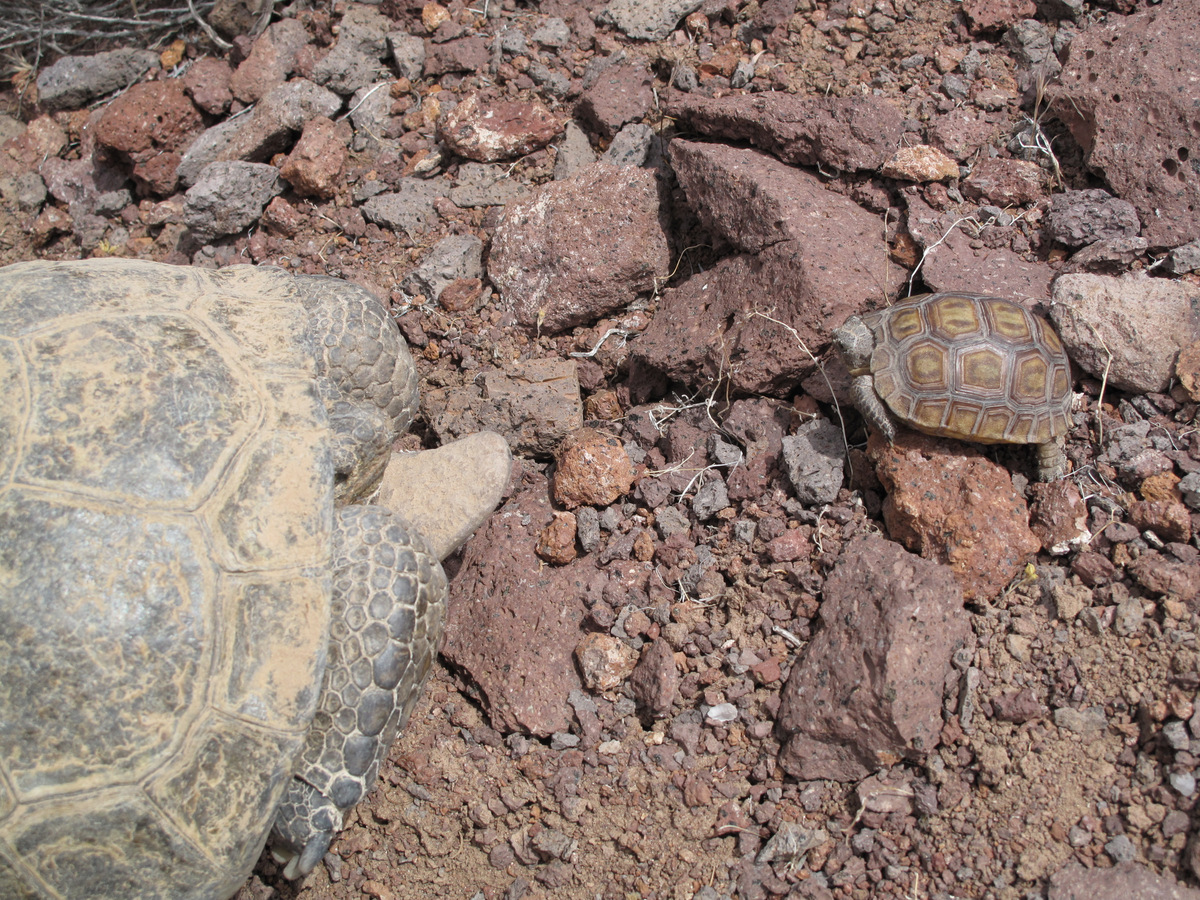
Click for a larger view of an adult and juvenile Desert Tortoise. Courtesy & Copyright 2009 Andres Durso, PhotographerAdult & Juvenile Desert Tortoise
Gopherus agassizii
Courtesy & Copyright 2009
Andrew Durso, Photographer

Click for a larger view of a juvenile Desert Tortoise. Courtesy & Copyright 2009 Andres Durso, PhotographerJuvenile Desert Tortoise
Gopherus agassizii
Courtesy & Copyright 2009
Andrew Durso, Photographer

Tortoises are turtles that live their whole lives on land. Most tortoises are native to Africa and South America, but several are North American including the Desert Tortoise whose range extends to southwestern Utah. Their shells consist of enlarged scales called scutes. These scutes are tan, black, or dull orange, and etched with many concentric lines, like the growth rings of a tree. Desert Tortoises look like grizzled old men, even the Oreo-sized hatchlings, which over several decades will grow to football size.

Desert Tortoises mate in the spring, and a few months later, the female lays her 5 or 6 eggs in a funnel-shaped pit dug in the sand. The sex of the baby Desert Tortoises is determined by the sun’s heating rather than by genetics – cooler incubation yields males, hotter eggs produce females, with a mix of sexes developing at intermediate temperatures.

Desert Tortoises primarily eat the flowers of desert plants such as globemallow and threeawn. Because most desert plants only bloom briefly each spring, tortoises must eat a lot between April and June, although they can be active during all but the coldest months. Being toothless, they grind up their vegetarian fare using a specialized bone embedded in their jaw muscles. Like cows and other herbivores, they depend on microbes in their gut to digest the cellulose in their diet. Even more than food, water is precious to a Desert Tortoise. They have little to spare, sometimes going for months without urinating, but will pee defensively if handled. Resist the temptation to pick them up or you will rob the poor animal of its water supply for the entire year.

Once found throughout the Mojave and Sonoran deserts, Desert Tortoises are much less common than they were a century ago. They have not fared well with urbanization, highways, and off-road vehicle traffic. An upper respiratory tract disease can also be lethal, especially when crowded or stressed, as in captivity. Desert Tortoises are now protected by the US Endangered Species Act.

Today’s program was written by Andrew Durso of USU’s biology department.

Credits:

Theme: Courtesy & Copyright Don Anderson Leaping Lulu
Images: Courtesy & Copyright Andrew Durso and Kevin Durso
Text: Andrew Durso, https://www.biology.usu.edu/htm/our-people/graduate-students?memberID=6753

Additional Reading:

Gopherus agassizii, Turtle Conservancy, https://www.turtleconservancy.org/news/tag/Gopherus+agassizii

Grover, Mark C., DeFalco, Lesley A, Desert Tortoise(Gopherus agassizii): Status-of-Knowledge, Outline With References, USDA, 1995, https://www.fs.usda.gov/research/treesearch/30627

Desert Tortoise, Gopherus agassizii, Mojave National Preserve, https://www.mojavenp.org/Gopherus_agassizii.htm

Gopherus agassizii (COOPER, 1861), The Reptile Database, Peter Uetz and Jakob Hallermann, Zoological Museum Hamburg,
https://reptile-database.reptarium.cz/species?genus=Gopherus&species=agassizii

Desert Tortoise, Species, Utah Division of Wildlife Resources, Utah Department of Natural Resources, https://fieldguide.wildlife.utah.gov/?species=gopherus%20agassizii

Desert Tortoise Information and Collaboration, Mojave Desert Ecosystem Program, https://www.mojavedata.gov/deserttortoise_gov/index.html

Red Cliffs Desert Reserve, http://www.redcliffsdesertreserve.com

Tracking Wildlife in Winter

Jumping Mouse Tracks
Photo Courtesy & Copyright 2011
Mark Larese-Casanova

Moose Tracks in Snow
Photo Courtesy & Copyright 2011
Mark Larese-Casanova

Cottontail Rabbit Browse & Scat
Photo Courtesy & Copyright 2011
Mark Larese-Casanova

Hi, this is Mark Larese-Casanova from the Utah Master Naturalist Program at Utah State University Extension.

The cold depth of winter is a time when many animals are hiding- either hibernating until the thaw of spring, or finding shelter and warmth in burrows, under logs, or in the tangled branches of evergreen trees.

However, snow falls in much of Utah, and even a dusting can reveal the stories of wildlife in winter. It’s a bit like solving a mystery. By reading the clues of animal tracks, we can know not only the type of animal that made them, but also where they were going and what they were doing.

The most obvious clue is the size of a track. Smaller animals make smaller tracks, and also sets of tracks that are generally closer together.

The shape of an animal track is also very revealing. Members of the canine family, including domestic dogs, coyotes, and fox, show four toes in front, each with a visible claw. Felines, including bobcats and mountain lions, also show four toes, but no claws. Tracks from members of the weasel family, such as mink, ermine, and skunks, show five toes, each with a claw. Raccoon, squirrel, and mouse tracks almost look like they were made by tiny human hands. The long tails of some animals, including deer mice, jumping mice, and weasels, often leave a characteristic line through the center of a set of tracks.

Combining the size and shape of tracks reveals further details about wildlife. The three inch long cloven hoof print of a mule deer is easily recognizable. An elk track looks almost identical, but is about four inches long. A similar moose track is even larger at six inches long.

Figuring out which animal made a track is only half of the story. If we follow tracks, we’ll surely find clues about an animal’s daily life. Wildlife often gather around sources of water that aren’t frozen, which are critical to winter survival. Perhaps rabbit tracks lead under a spruce tree where browsed branches and droppings indicate a frequent feeding spot. Maybe mouse tracks lead from tree to rock to log as it avoids owls and hawks.

While we are much more likely to see wildlife during the warmer months, winter gives us a chance to unravel the story of daily survival during the most difficult time of the year in Utah.

For Wild About Utah, I’m Mark Larese-Casanova.

Credits:
Images: Courtesy and Copyright Mark Larese-Casanova
Text:     Mark Larese-Casanova

Additional Reading:

Canadian Wildlife Federation: Tracking Down Winter Wildlife. https://www.cwf-fcf.org/en/action/how-to/outside/tracking-down-winter-wildlife.html

Murie, O. J. (1982). Animal Tracks. Peterson Field Guides. New York, NY: Houghton Mifflin. https://www.amazon.com/Peterson-Field-Guide-Animal-Tracks/dp/061851743X

Vermont Nature and Outdoors: Tracking Winter Wildlife. https://www.ruralvermont.com/vermontweathervane/issues/winter/97012/vins97012_tracking.shtml

Baby, It’s Cold Outside

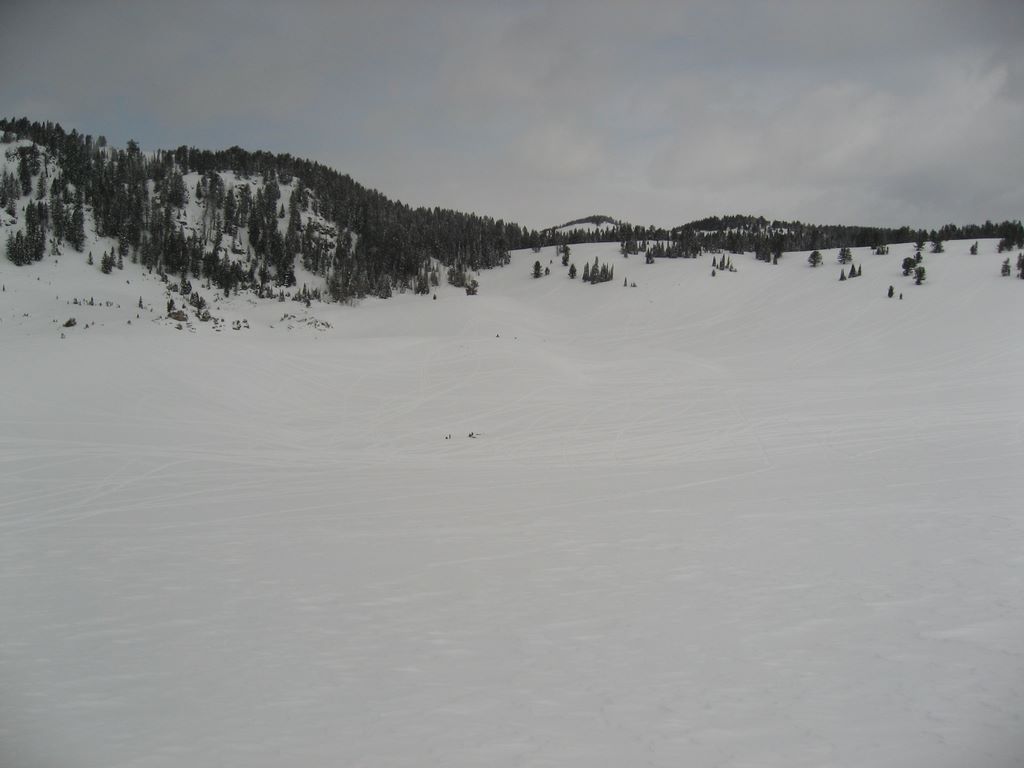
Baby, It’s Cold Outside: Peter Sinks.  Courtesy the Utah Climate Center

Peter Sinks
Courtesy Utah Climate Center

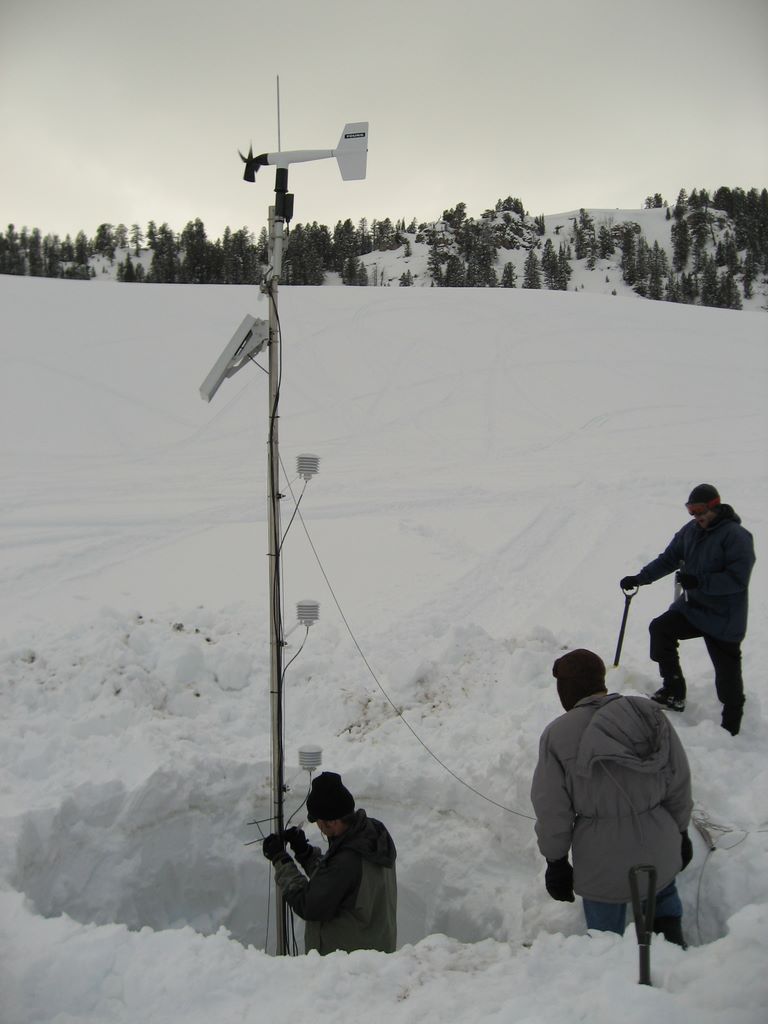
Peter Sinks
Campbell Scientific Weather Station

Courtesy Utah Climate Center

Holly: Hi, I’m Holly Strand.

-18 in Logan, -20 in Moab, -26 degrees in Randolph. In other words, it’s January in Utah! Subzero temps are common this time of year across most of the state.

Some sources give – 50 degrees Fahrenheit as the coldest temperature ever recorded in Utah. It was -50 on Feb 6, 1899 in Woodruff and again on Jan 5, 1913 at the East Portal of Strawberry Reservoir. But—as many of you know—the real lowest temperature recorded was -69 degrees occurring at Peter Sinks on Feb 1, 1985. There were two weather stations recording at the time. A Campbell Scientific instrument recorded a temperature of -70.5 from a sensor 20 inches above the snow surface. A few days later, USU student Zane Stephens retrieved a minimum recording alcohol thermometer which registered -68.3. The National Bureau of Standards calibrated Stephens’ thermometer which adjusted the reading to -69.3. This became the ‘official’ temperature minimum since– at that time–the National Weather Service only recognized the type of weather station used by Stephens.

While the -69 observation was verified, the station it came from was not part of any long-term weather monitoring network. That’s why you still see the -50 cited as the low. But -69 is so much better. For this figure gives Utah boasting rights for having the 2nd coldest recorded temperature in the lower 48 (plus Hawaii). -69 beats the coldest temperature recorded in Europe which is only -67. And it comes fairly close to North America’s record which is -81 in the Canadian Yukon. Just so you know, Asia’s record is -90 in Verkhoyansk in Siberia. And of course, Antarctica takes the cake with -129 at Vostok Research Station.

But back to Utah. Peter Sinks—where the -69 reading occurred–is an oval-shaped limestone sinkhole located on the crest of the Bear River Range just west of Old Limber Pine off of Highway 89. It’s about 150 meters deep and 1 km long. Having no tributary valleys, it’s a perfectly closed basin. On clear nights the area surrounding the sink radiates away its heat. And if the wind is calm, the, colder heavier air sinks and pools on the basin floor . If there were an outlet the cold air could flow out and warmer air could lower in to replace the outgoing cold. But there isn’t an outlet.

You probably recognize this situation—it’s an inversion. The Wasatch Front valleys and Cache Valley experience this same phenomenon during winter. Snow cover reflects incoming sunlight which cools the land surface and warm temperatures aloft seal the colder air down below. Meanwhile, a high pressure system called the Great Basin High brings clear, still air which locks the inversion in place. But the large size of these populated valleys prevents the temperature from dropping down to -69. Thank goodness. But in our case, manmade pollutants created during the inversions create a toxic cold air cocktail that we have to endure. At least until a low pressure system comes in and blows the lid off the inversion, pulling the cold air upward and “mixing” it away.

For more information on inversions and to see pictures of the notorious Peter Sinks, visit www.wildaboututah.org

Thanks to Robert Davies of the Utah Climate Center at Utah State University for his help in developing this episode.

For Wild About Utah, I’m Holly Strand.

Credits:

Image: Courtesy Utah Climate Center
Text: Holly Strand

Sources & Additional Reading:

Ahrens, C. Donald, Perry Samson. Extreme weather and climate. Belmont, CA : Brooks/Cole, Cengage Learning.

Clements, Craig B. Whiteman, C. David Horel, John D. 2003. Cold-Air-Pool Structure and Evolution in a Mountain Basin: Peter Sinks, Utah. Journal of Applied Meteorology, Jun 01, 2003; Vol. 42, No. 6, p. 752-768

Moller, Allen; Robert R. Gillies. 2008 Utah Climate. Logan, Utah: Utah Climate Center, Utah State University

NOAA, State Climate Exchange Committee. State Temperature Extremes https://www.ncdc.noaa.gov/extremes/scec/records

Utah Climate Center, Utah State University https://climate.usu.edu/

Utah Climate Center with support from Campbell Scientific, Inc. Peter Sinks Monitoring Project. Site history, data and more pictures. https://twdef.usu.edu/Peter_Sinks/Sinks.html

Utah.Gov Choose Clean Air https://www.cleanair.utah.gov/

Properties of Water

Click for a larger view of water as frost on a window, Courtesy and Copyright Andrea Liberatore
Water as frost on a window
Courtesy and © Andrea Liberatore

Click for a larger view of water surface tension on a quarter, Courtesy and Copyright Andrea LiberatoreSurface tension – water drops
on a quarter
Courtesy and © Andrea Liberatore

Click for a larger view of water as snowflakes, Courtesy and Copyright Andrea LiberatoreWater as snowflakes
Courtesy and © Andrea Liberatore

In our winter wonderland, water is all around. It piles upon the landscape in great white drifts. It is a substance life is completely dependent upon and as ordinary as it seems, this tasteless, odorless substance is actually quite amazing. Up to 60% of our body mass is due to water, and life as we know it would not exist if not for water’s unique physical properties.

When most known liquids get colder they contract – shrinking around 10 percent in total volume. Water contracts too, but only until it reaches its freezing point, at which time it reverses course and begins to expand. This molecular marvel does wonderful things for life on earth. As water freezes and expands, the resulting ice becomes lighter than its liquid form, causing it to float. If ice contracted as other liquids do, it would sink, and lakes would freeze from the bottom up – and freeze quickly, meaning big changes for aquatic life. Water in all forms happens to be a very good insulator, meaning that it doesn’t change temperature very quickly. Ice floating on top of a pond insulates the water underneath, keeping it warmer, and therefore liquid, longer than it normally would. Obviously this is beneficial for local creatures like fish and beavers not to mention the penguins, whales and seals that thrive in the colder parts of our planet.

Another critical property of water is its stickiness. Individual molecules are generally more attracted to each other than to other substances such as air or soil. This ‘stickiness’, or cohesion, creates surface tension, which allow puddles, rivers, and raindrops to form, and also enables water striders to glide on the water’s surface and rocks to skip across a lake. Water tension is also responsible for a tree’s ability to siphon water from the soil and transport it to the very topmost leaf. However water’s bonds aren’t so strong as to be unable to break when a fish swims through or when you cannonball into the deep end. You can observe surface tension at home by dripping water onto the head of a coin, and watching it ball up into a surprisingly large mound.

Water is also one of the only known substances that naturally occurs in three phases – solid, liquid, and gas. This is important to many facets of life including the proper functioning of the weather system as we know it. Thankfully, there is a lot of water here on earth – about 320 million cubic miles of it. However, only four tenths of a percent of that comes in the form of freshwater lakes & rivers. Most of the rest is locked up in glaciers and oceans. It’s also important to realize that this is all of the water that Earth has ever had, and all the water we’re ever going to get, which can lead to some interesting thoughts about where that water you are about to drink has previously been. Perhaps it was once part of Lake Bonneville, in the snow that fell on the back of a wooly mammoth, or in a puddle slurped up by a brachiosaurus. If only water could talk…

For more sources and to calculate your water-use footprint, visit our website at www.wildaboututah.org.

For the Stokes Nature Center and Wild About Utah, this is Andrea Liberatore.

Credits:

Images:  Andrea Liberatore, Stokes Nature Center in Logan Canyon.

Text:     Andrea Liberatore, Stokes Nature Center in Logan Canyon.


Additional Reading:

Bryson, Bill (2004) A Short History of Nearly Everything. Broadway (Random House): New York.

U.S. Geological Survey (2013) The USGS Water Science School. Accessible online at: https://ga.water.usgs.gov/edu/

United Nations: Water. Accessible online at https://www.unwater.org/

Calculate your water footprint:
https://www.waterfootprint.org/?page=files/YourWaterFootprint